Send Mode / Search Mode
Backcountry in the Sierras, Three Days Before the Castle Peak Avalanche

I am standing in a parking lot in California’s Central Valley, somewhere between Modesto and Fresno, and my sister explains that there has been an avalanche. The last time she saw the person was near the back of the car. I flip my avalanche beacon from send mode to search mode. The device points toward a pile of rocks, counting down the number of meters until I am standing over the buried beacon. I mime stabbing at it with a probe. “Now we would dig” she says. It is midnight and we are charging the car in a Walmart parking lot. On the way to a back-country ski trip in the Sierras, every stop becomes an avalanche safety refresher.
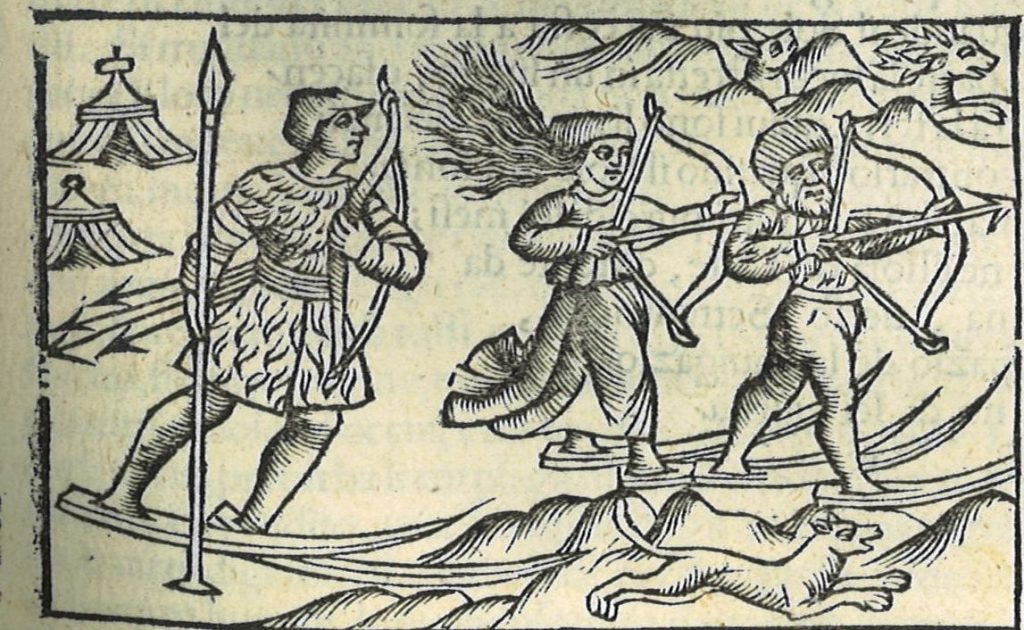
To travel in the backcountry - what the Europeans call skiing off-piste - you need to be able to move uphill under your own power. The preferred way to do that is to use something called skins, once literal animal hides, now a synthetic cover that sticks to the bottom of your skis. The first account of skins appears in Olaus Magnus’ A History of the Northern Peoples in 1555, detailing Norwegian travelers using the directional fur of the ‘skin of a young fawn’ to slide up the hill but not back:“when they ascend to a place they may not fall backward: because the hair will rise like spears… and by an admirable power of Nature hinder them from falling down.”
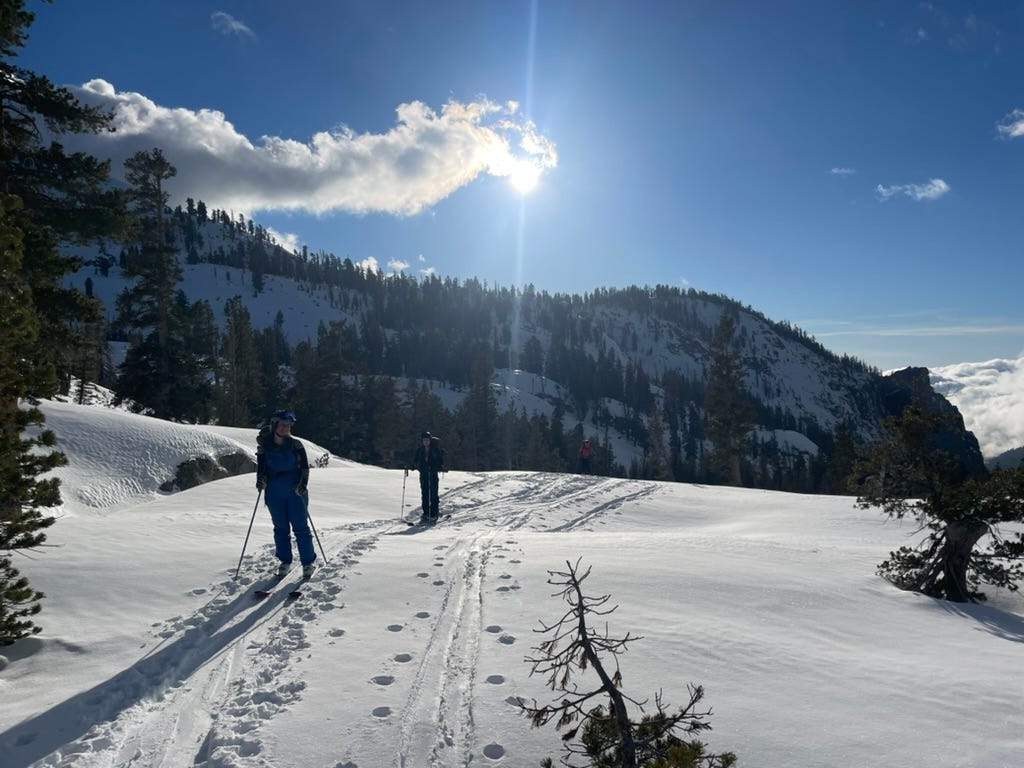
Our backcountry skinning crew is a party of five - myself, my sister and her friends Jon, Tommy and Rachel. Jon skins up on a splitboard, with two ski halves that will clip together into a snowboard for the descent. Tommy serves as our unofficial guide, refreshing the topo map to make sure we are following our intended path. Route planning means reading slope angle - under 30 degrees snow rarely slides; over 50 it rarely builds; in between is the danger zone for shifting slabs. I’m reassured that Tommy, Rachel and Jon, all of whom are experienced with overland snow travel, are also new parents, making decisions with their little ones at home in mind.
About a mile into the trail the snow becomes consistent enough for us to strap on our skis and begin skinning up the mountain. We are in Sequoia National Park, home of some of the biggest trees in the world. But it is fir trees, not sequoias, that surround us as we make our way on the safe winter route up and over The Hump, a 9,500 foot sloped peak. At the top we can see deeper into the Sierras, and almost all the way to our destination for the night, the Pear Lake Ski Hut.
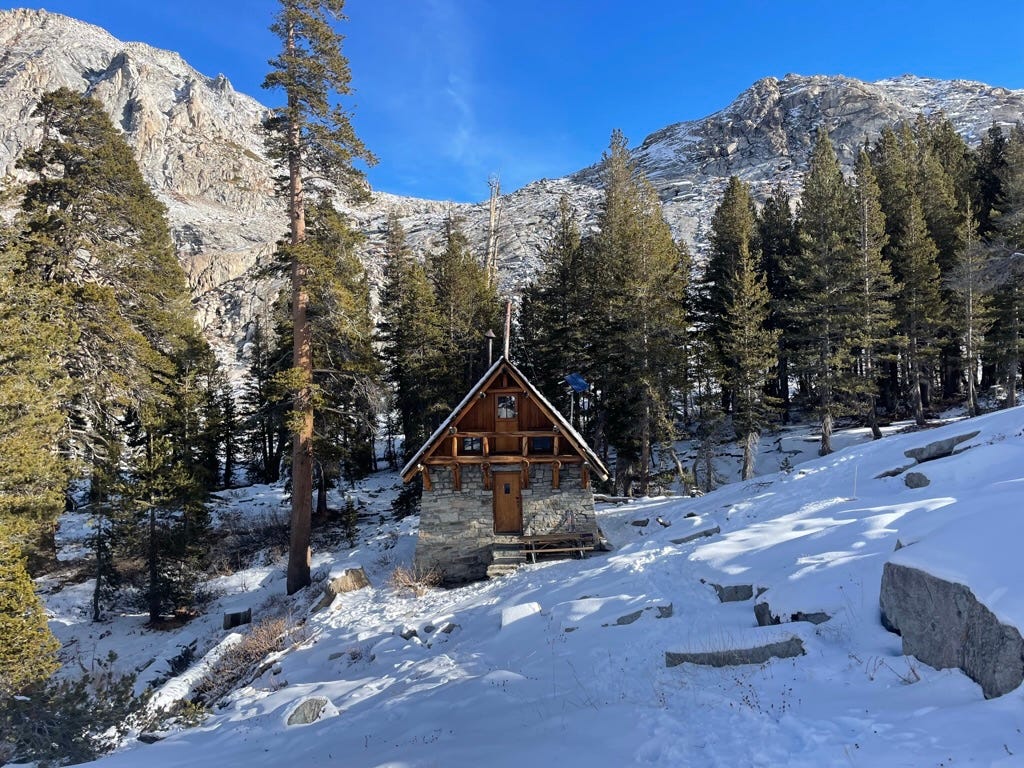
We glide over the top of a lake dusted in snow. It is surrounded by waterfalls frozen midstream and we can see tracks from other travelers, human and marmot. As we descend the extra weight of my backpack makes skiing motions clumsy, and I struggle to maintain my form. But after a few good hours we round a corner and the hut appears, visible through a cluster of trees, nestled in the glaciated headwaters of the Marble Fork drainage. The hut’s solid stone walls, constructed by the Civilian Conservation Corp in 1939, promise warmth from the cold slopes.
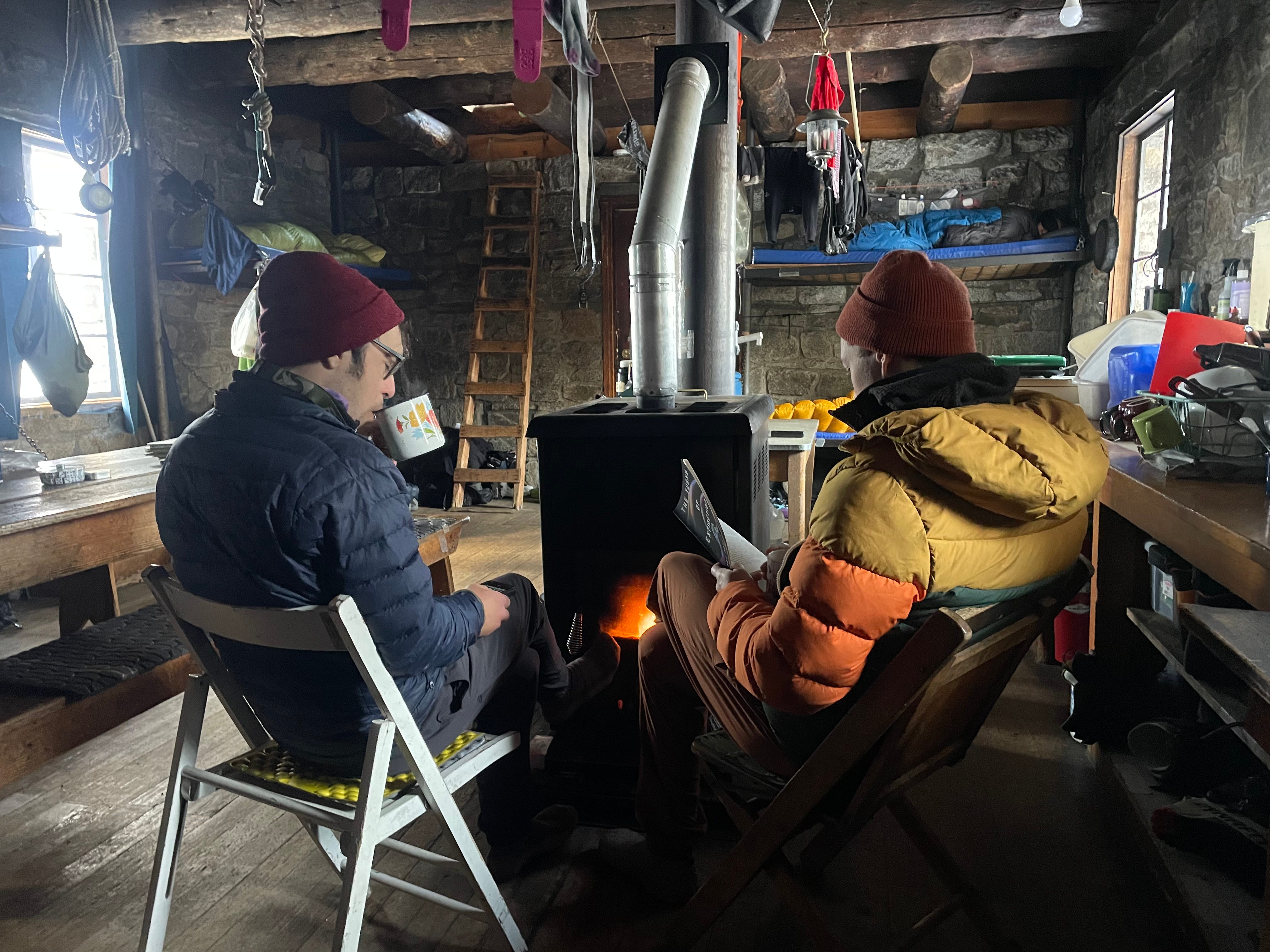
Set along the walls of the hut are five bunk beds, which surround a kitchen area and an old pellet stove nicknamed Tinkles. In the back of the building is a small room with a conveyor-belt composting toilet, though guests are also encouraged to use the outdoor excavated ‘pee platform.’ Due to the government shutdown the season is short, since only half the pellet mules made it up to the hut. We were lucky to get a reservation.
The hut has log books going back to the 60’s with stories of adventures and close calls. In one particularly memorable account a group of skiers were lost in whiteout conditions and had to huddle in a constructed snow fort for two nights before making it back out to the visitor’s center. In another, the snowpack was so high the group was worried about the pressure on the roof and tried to trigger a ‘rooflanche.’ Remarkably, it seems the closer the call, the more likely the group is to return the following year, recounting their narrow misses with some combination of reverence and glee.
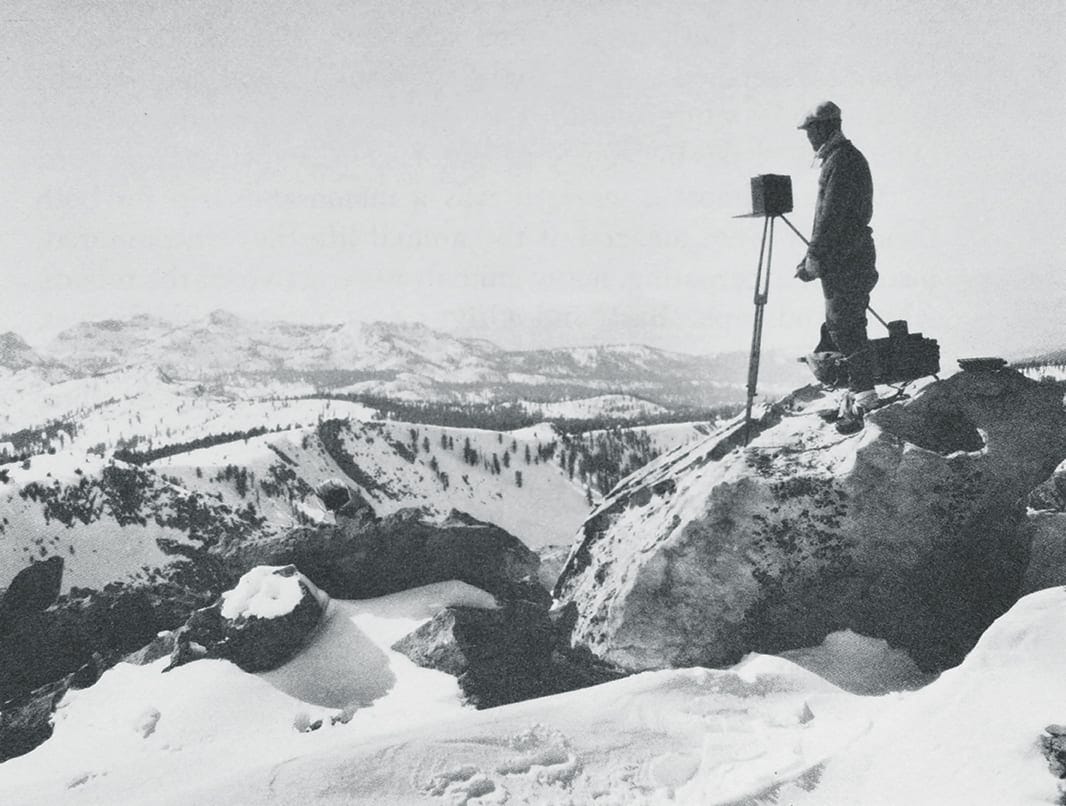
Tucked in the corner is a small library, filled with books about the High Sierras. At the recommendation of Lacey the hutkeeper, I crack open High Odyssey by Gene Rose. It recounts the solo expedition of Orland Bartholomew, who from 1928 to 1929 undertook the first recorded winter traverse of the Sierras and of Mt. Whitney, spending 40+ nights above 10,000 feet. Rose writes that Bartholomew was a “mountain greyhound who could cover the rough distances of the high country faster than a horse.”
Bartholomew’s experience as a trapper and stream gauger for Southern California Edison gave him a unique vantage point on skiing the Sierras, and he spent the summer beforehand caching food along the route, giving him the pack space to bring his photography equipment along for the journey. Bartholomew crossed high passes alone in winter without avalanche forecasts or beacons or a partner to dig him out. Whatever judgment he possessed, it operated without the illusion of backup. Aside from a single report for the Sierra Club Bulletin, Orland would rarely talk about his feat, with his own son only learning the full story from his father’s journals after his death. I wonder if that silence was humility — or recognition that survival is not the same thing as righteousness. On the final day of his journey, Orland wrote a simple diary entry:
For they who are tired of planning & toiling, In the crowded hives of men;
Heart-weary of building & spoiling, And spoiling & building again,
they offer a chaste solitude and sweet council.
And from these the devout will come with a new song.
The next morning we skin up another 2,000 feet and are looking out over the Central Valley, watching the fog make a partial pass up into the mountains. The Sierras have been sending eroding rock into the Central Valley for millions of years, but today the valley is sending a message back via our walkie-talkies. We hear the chatter of two people in a repair shop going back and forth on Channel 12, breaking our illusion of complete solitude. Jon radios down to us from the peak that he is going to ‘drop in’ and snowboard down. ‘Get it buddy’ comes a crackling reply from a stranger in Fresno.
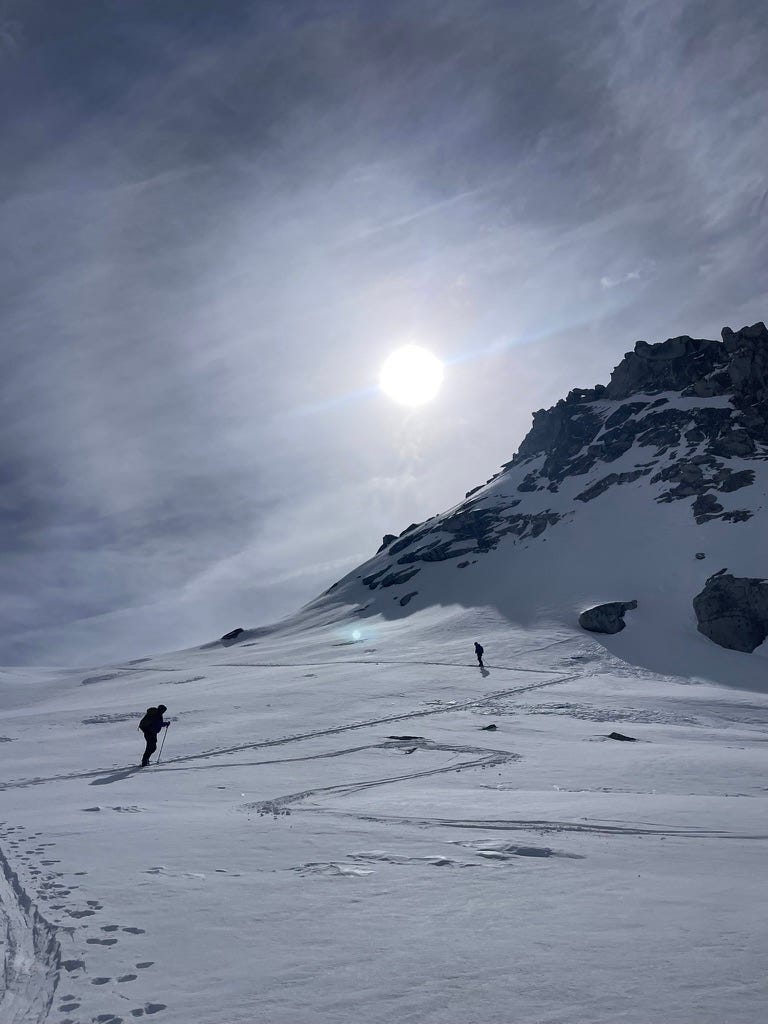
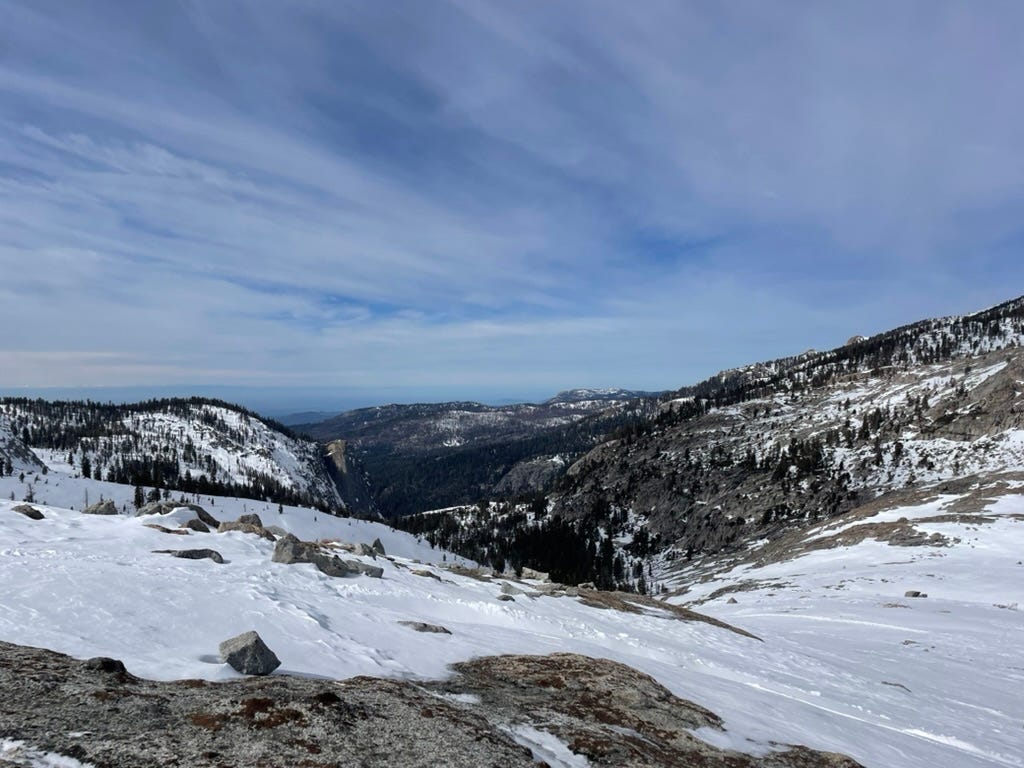
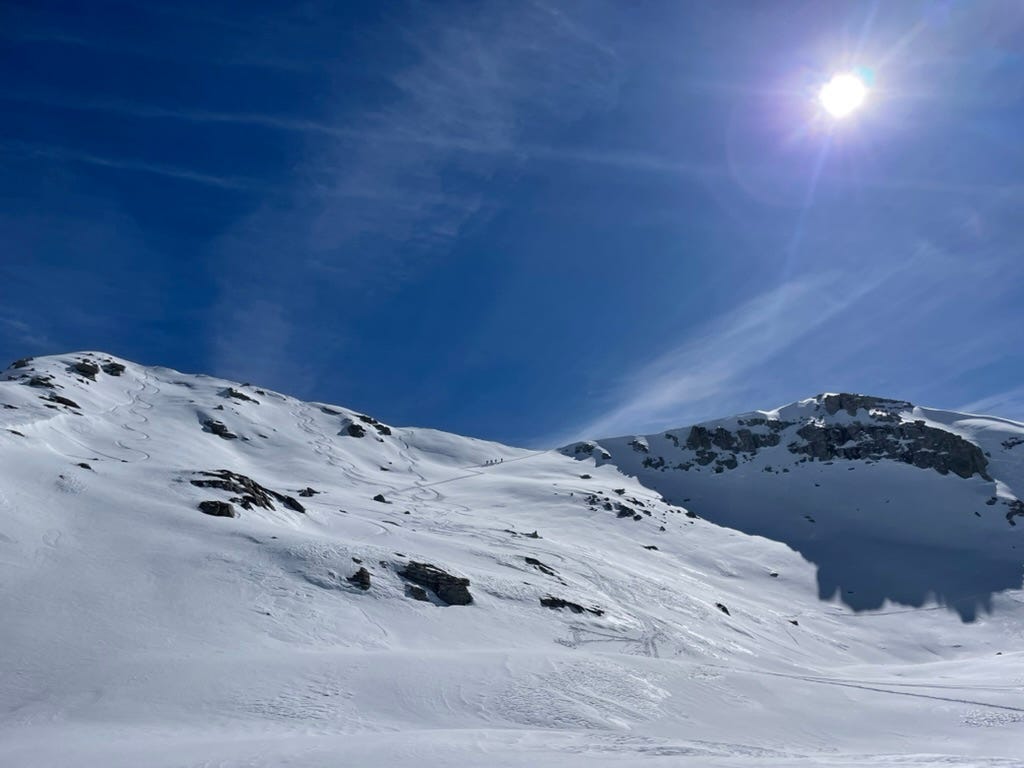
I am reminded of Kim Stanley Robinson’s writing on the ‘psychogeology’ of the Sierras, the difference between being ‘on the outside’ and ‘inside’ the range. When you are on the outside you can look out from the mountains to the valleys below, but when you are inside you only see mountains in every direction. I am on the outside of the Sierras but it is enough. On the basin below I can see perfect s-shaped lines where yesterday’s travelers made fresh swooping marks on their way down.
I tip forward and am flying down the slope. The powder is deep, and I cut my own lines. Each ascent that took half an hour to skin up flies by in seconds. We are above the tree line, so the only hazards are rocks and sliding snow. I am trying to remember to shift from side to side, to use the edges of my skis. I can’t believe we have the mountain to ourselves, that we have gotten ourselves here on our own power.
That night we gather around the pellet stove, drink amaro, and sing. We end with a traditional Scottish song, The Parting Glass.
But since it fell into my lot
That I should rise and you should not
I’ll gently rise and softly call
Good night and joy be to you all
So fill to me the parting glass
And drink a health whate’er befalls
Then gently rise and softly call
Good night and joy be to you all
Three days later I am standing in the kitchen of a house in South Lake Tahoe and my sister explains that there has been an avalanche. This time it is not a drill. The deadliest avalanche in modern California history struck a party skiing back from a hut trip in the Castle Peak area of North Lake Tahoe, claiming nine lives. The avalanche report reads “A group of 15 backcountry travelers were involved in an avalanche below Perry’s Peak around 11:30 am on Tuesday Feb 17, 2026. 12 people were caught in the avalanche. Remaining members of the party performed a companion search and were able to rescue 3 buried individuals.”

A companion search — beacons out, counting down the meters, digging — rescued three people buried in the snow. I notice how quick I am to jump to questioning their decisions. Why would anyone ski out on a high avalanche danger day? Why not hunker down at the huts, or leave a day early? What’s the point of having guides and radar and the Sierra Avalanche Center if you’re going to ignore the forecast?
Part of what is happening is I am trying to distance their choices from my own, construct a rationale for why they were doing something dangerous but I was not. Only later do I learn that six of the group were mothers.
I am chastened when I hear an interview with Bruce Tremper, author of Staying Alive in Avalanche Terrain. “In almost all of the accidents that I’ve investigated” he explains, “when I put myself in their shoes, it’s like: ‘Well, I could have done that.’ In fact, I have done that before — but I’ve gotten away with it.’” Tremper is describing what has sometimes been called a reverse slot machine: you pull the lever a hundred times and nothing happens, which is what makes the next pull feel safe.
It’s easy to say the last decision is the one that shouldn’t have been made, but the only choice with no risk is to stay home. Kiren Sekar said of his wife: “Caroline spent her final days doing what she loved best, with the people who loved her most, in her favorite place.” Before heading into the waves, Japanese surfers bow to the ocean. I think about what reverence means in the mountains — a little superstition, a willingness to turn back, the humility to know that survival is sometimes indistinguishable from luck. Suspended between safe and unsafe, between buried and free.
Wow! Lovely, moving piece. I feel like I’m with you all in those beautiful mountains.